Showing posts with label Magic. Show all posts

15 April, 2012

3 Spells for OD&D

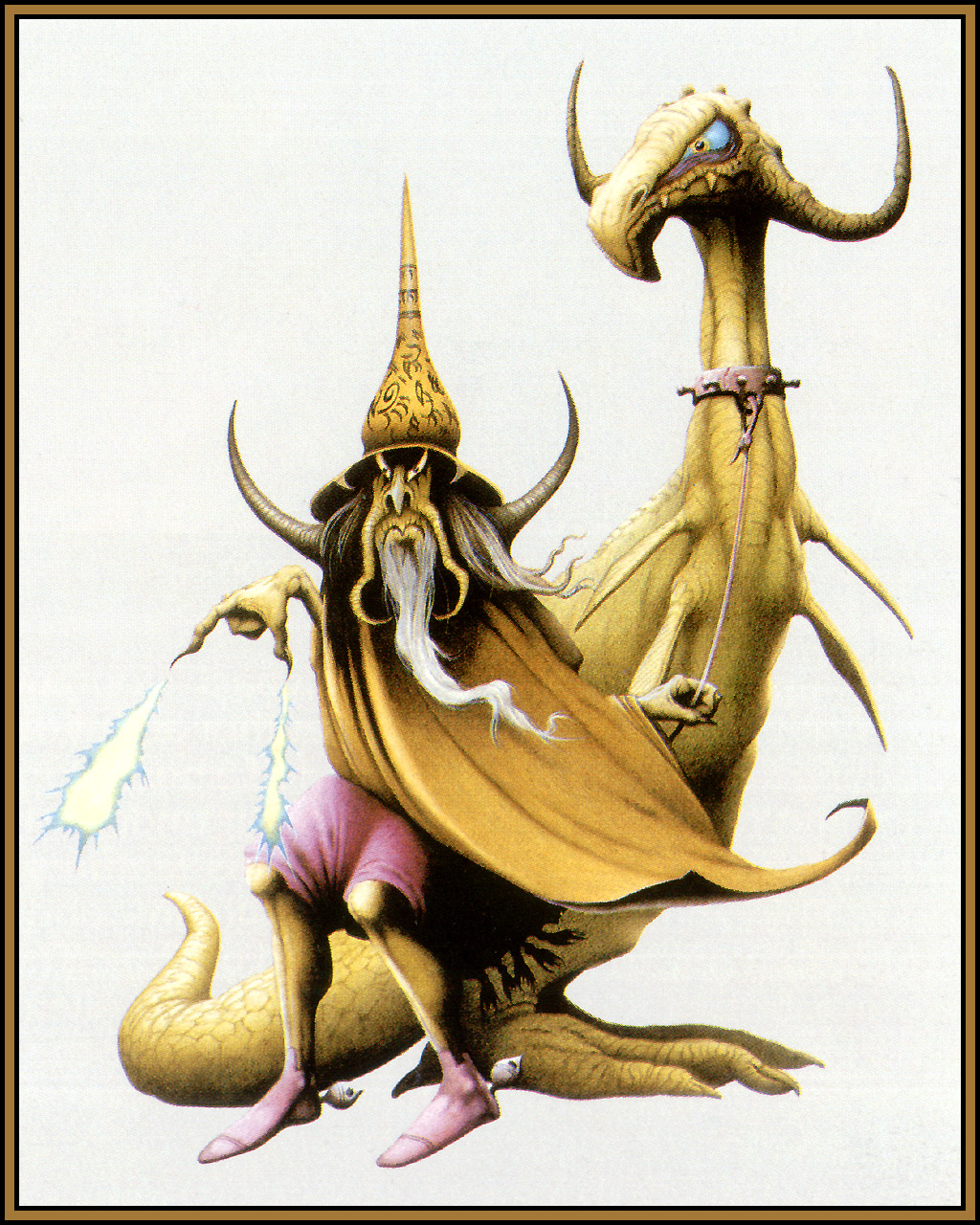
Rodney Matthews is freexin awesome
Escher's Thaumaturgic Disjunction
Level 2
This spell will catastrophically disrupt another spell being cast, as long as the target spell is of 1st or 2nd level. The caster of the target spell must make a successful save vs. spells or suffer one of two possible consequences, as decided by the Dungeon Master. The caster either takes 2d6 damage, or must roll on the Dungeon Master’s choice of Magical Mishap Tables. Range: 4”

Fire Slugs
Level 1
This spell is similar in every way to Magic Missile, except that it specifically causes fire damage. Instead of bolts of magical energy, it shoots forth small, slimy, lava-like fire slugs. They dissipate into vapour as soon as they hit, completely preventing them from being able to set anything on fire. The only exception is if the target has been doused or covered in some flammable substance, such as lamp oil. 

Copperfield's Phantasmal Remuneration
Level 2
This spell creates up to 10 gold pieces worth of local currency for every level of the caster. It can take any accepted form, but no more than 1 lb. per caster level can be created. The illusory currency lasts for 1 turn per caster level, then turns into a worthless base material chosen by the Dungeon Master. Gold coins become lead discs; small gems become pebbles; paper currency becomes strips of town-criers parchments; etc.


13 February, 2012

Wizard Cantrips

Magic-Users in my campaigns are able to put their sorcerous learning to work at any time by using cantrips. These aren't the cantrips detailed in any published sourcebook, and they aren't written down in the wizard's spell books either. They are extemporised instances of magic. The magic-user uses his creativity and knowledge, his years of learning, his acquired talent for manipulating the fabric of reality, and he makes magic. Very minor magic.

If using a cantrip on a creature, or something held or worn by the creature, a saving throw vs. spells is allowed the potential victim to nullify the effect. The maximum mass of an affected item is one pound. The maximum area of effect is roughly a ten foot cube (not an exact or perfect cube, of course.)

Thus, a mage makes a hand motion, utters some arcane syllables, and the log in the hearth lights. He says a few more strange words, and his breakfast dishes are clean. It's not very bright, so to look through his pantry he works his fingers and says a word, and a small bright point of light appears. It lights up an area of about 10 feet. A fly is buzzing around, distracting him, so he mutters, points a finger, and it flashes out with a pop. Bah, his little light went out when he stopped thinking about it. Through the window, he sees the bill collector. He utters an odd word, works his hands, and (with a failed save) sets a small spot on his shirt on fire.

They can't directly cause even 1 point of damage, but of course a fly or a bee doesn't have even 1 hit point. It's imagination time!

01 December, 2011

Messing With Magic Again

Little gnomes stay in their homes.
I’ve gone over this ground before, but today I’m riding it on a different horse. In getting ready to run a hangout game on G+, I needed to make a decision about two main things. Magic and hobbits.

It isn’t that I don’t like hobbits. I think hobbits are great. I love their anachronistic lifestyle, with waistcoats and sideboards and grandfather clocks plopped in the middle of a medieval milieu. However, I also think hobbits only really belong in Tolkien’s Middle Earth. Sure, there are little tiny people in lots of legends and myths and tales, but they’re not really hobbits. Leprechauns and brownies and hobgoblins are not hobbits. Hobbits are setting-specific.

Now back when I ran my old old game, I said it took place on Middle Earth.. just not a part of Middle Earth anywhere remotely near the events of the books. This let me put in hobbits and other things with a clear conscience. I think I’d like to distance myself from that idea though, and have events take place in their own world. Thus, for now at least, no hobbits. Instead, folk-myth gnomes. Smaller than hobbits, remotely similar anachronistic lifestyle, living in and under trees instead of in and under hills. A big difference is that these little gnomes aren’t skittish about adventures or magic.

That’s sorted! Now for magic.

The problem with magic is the same. The system used by DnD throughout most of the game’s history, and used also by the overwhelming majority of similar games, is setting-specific. The idea of only being able to hold, like bees in a jar, a certain number of spells within one’s mind, and then having them disappear to blankness upon casting, is very interesting. It makes spellcasters engage in some strategic decisions, which is a good and interesting thing. However, I also think it only really belongs in Vance’s Dying Earth. The majority of magic in old legends and tales just isn’t done that way.

The problem with all the ideas I was having about how to deal with magic boil down to pretty much one issue. How do I keep magic from being overused without adding more mechanics to the game? Spellcasters in stories clearly have something against blasting a zillion spells around all the time. Something to do with the balance of nature and not wanting to incur the wrath of chaos or dark outer gods or something, I’m sure. Spell points are too fiddly, I’ve decided. Besides, what are those points measuring? Fatigue of some kind? Fabled spellcasters only seem fatigued after certain specific things, not just everything. On the other hand, I hate it when perfectly interesting spells go unused for ages and ages because the likelihood of needing them is so low.

Here’s what I came up with!

Casters use the memorisation tables in the rules they’re currently using. For an OD&D magic-user, for example, this means 1 first level spell at 1st level, 2 first level spells at 2nd level, etc. They also say which specific spells they have prepared, just like usual.
But!
Their prepared spells are just the ones they have at the front of their mind, ready at a moment. They can, instead, cast any other spell they know of the same level, but at twice the casting time. Have Sleep prepared and want to cast Charm Person instead? No problem, but it will take you 2 rounds to cast that Charm Person instead of just 1. A big difference when death is on the line!

What if your 2nd level magic-user has already cast two 1st level spells and needs to cast another? Same thing - it will take double the casting time to get it off. That’s not all though. For exceeding that spells-per-level number on the memorisation chart, you need to roll a good old fashioned save vs. spells when you cast it. If you make the save, no worries. Fail the save, and you have to roll on a spell failure table. Instead of creating extra work, rolling on a table if you fail should just create some anxiety and suspense, which are great things for a game.

Ooh, a table!
No, I didn’t make one of my own yet. I’ve seen several out there that looked pretty neat. If you’ve made a spell failure table for some reason, stick a link to it in the comments down there. :)

This also works if you want to let spellcasters attempt spells which are beyond their current ability, something which happens in the stories now and then. Apply penalties to the save vs. spells depending on how far beyond their abilities they’re trying go. I wouldn’t allow a 20 to always succeed in this case, either.

One more thing I’ve decided. A character can only benefit from one casting of any specific healing spell once per day. Once Dilbod has been healed by a Cure Light Wounds, the magic needs some time to sink in before another Cure Light Wounds will have any effect on him, regardless of who casts it. A different spell, like Cure Serious, could help him some more before tomorrow though. This may be fairly harsh, but I think it’s necessary if I’m giving casters a way to exceed their limits. I’ll allow people to bind open (only) wounds to stop bleeding and get back 1hp, once for each combat in which they get themselves hurt.
28 February, 2011

Starting Spells

I've used many different methods for determining what spells magic-users (and sometimes clerics) have scribed in their first spell book when they enter the game. Sometimes it's all first level spells, sometimes it's just one, or one plus their INT modifier. Sometimes it's according to the (surprisingly restrictive?) table on page 8 of the Greyhawk supplement. Sometimes the spells themselves are picked by the player, or randomly determined, or sometimes a mix of both.

In your campaigns, what do 1st level magic-users get in their first spellbook? Please let us know!

05 February, 2011

Ephemeromancy

"First of all, this isn't a new class. It's merely a different method of casting for a magic-user. In most of my milieu, there are dozens of different casting systems by which a worker of magic can cast their spells. Generally, characters will start out with a very basic system, much like or identical to what is detailed in the rules, and will then discover other casting systems as they travel around and experience the different cultures of the world, or worlds." - me
The system below is, obviously, a familiar one. However, it is presented here mostly in the context of starting with another system and discovering this one in the course of the campaign. If this is the case, it may be entirely appropriate to greatly increase the difference in power between spell levels, with even the first levels being of considerable power, while lowering the number of each level which the mage can commit to memory at any one time.
In my worlds, this form of wizardry goes hand in hand with the sort detailed in the works of Lovecraft. While anyone might dare to peruse the pages of the Necronomicon or the Book of Eibon, and attempt to cast the spells therein, the vast majority do so at the great peril of their mental stability. There are a handful of masters, however, who have painstakingly learned the techniques of ordering their minds in such a way that the howling chaos of raw magic may be safely contained within their conciousness... for a time.

Ordered chaos is the defining character of an ephemeromancer. Through practised forms of intense concentration, he can partition a prison against madness within his thoughts. He then populates this bastion with the same spells which would erode other mens' sanity. Then, as the memories are utilised, the inverted fortress shrinks within his mind, allowing his normal psyche more breathing room.

The wizard, after allowing his serotonin levels to normalize through sufficient sleep, can then once again enforce this neuroplasticity on his mind, rebuilding his asylum of chaos.

As befitting those so learned in ordering chaos and rigidly controlling their psyche, ephemeromancers have developed a complex system of power level assessment through which they catorgorise the known spells. As one advances in power, he will know precisely how many spells of a certain power he has the skill to confine within his mind.

However, woe be to any who dare look within the ephemeromancer's books, for if they chance to understand the ancient languages in which the arcane instructions are scribed, it is sure to have a lasting effect on their sanity. Although, they may also attempt the thaumaturgy themselves, but to potentially inexpert ends.

This system of magic can use any of the multitude of published sources which divide spells into levels of power, and which then specify how many of each level may be remembered at any one time by the mage, then to be wiped from the mind upon use.

03 January, 2011

Roll a d20 To Cast

The holiday season has left me mentally barren. I expect to recover soon.

In the meantime, I've been considering overhauling the basic underpinnings of magic use in my games, both wizard magic and cleric magic. My main intent is to have spellcasters rolling a d20 to cast a spell, just like players roll a d20 to make an attack. Since my main desire is some sort of equanimity, that means the higher the die roll, the better the spellcast.

Just like any system-fiddling, the first question is 'why bother, it works now.' Simple - I don't really like how it works now. I want my spellcasters doing magic. I'd rather it was more magic with less surety than less magic with more surety. I think that makes for a more interesting situation. Would it be any fun to play a fighter if you knew that you were guaranteed to do damage when you tried to hit.. but that you could only try to hit something once or twice a day? I'm thinking no.

I also have no interest in a wizard rolling 'to-hit' with their magic missile. Lame. I'm looking for something more interesting than that. I'm also thinking mostly about combat-related or time-sensitive magic. To be honest, if you can cast detect magic I don't really care how many times a day you cast it. Conversely, you probably don't care if it takes you 15 to 20 minutes to cast it. I think that's a pretty good trade-off, but I'd still like to see a d20 roll anyway, perhaps with a much easier target number, but with a chance to screw it up and make something bad happen, or even at least waste your time.

I love examples!

Charm Person: failure results in the intended target becoming insensibly enraged at the casting magic-user. They will immediately do their best to kill the magic-user, disregarding all other considerations to do so, including their own safety.

Detect Magic: failure results in a roll on the sensory mishap table.

Feather Fall: failure results in a roll on the minor physical mishap table, with all results visited upon the mage in the form of feathers and/or down.

One thing I really like about the take on this kind of system from James of A Dungeon Master's Tale is how (basically) target numbers get harder the more frequently you use magic. For what I'm after, the tables would look a lot more like one of Zak's tables, and the difficulty of successful spellcasting wouldn't increase quite as steeply as in James' system.

I'll keep thinking about this.. please throw ideas at me.

01 November, 2010

Leycaster


Not a new class, but rather another option for the method of a magic-user's madness, the Leycaster uses ley lines to power and shape his wizardry. Not only does a caster's distance from a ley line determine how strong his spells might be, they may also dictate the most efficacious type of thaumaturgy for the area. In some cases, the presence of certain types of ley lines might even provide the imaginative magic-user with the raw energy needed for the spontaneous weaving of singular sorceries.

The first thing a trained Leycaster learns is how to attune his senses to the presence and power of the lines. Not all wizarding adventurers need be skilled in this endeavor, but one who uses the ley lines will immediately sense their presence. Does this require the DM to map out a complex network overlaying his milieu? Although the option is there to place lines for specific purposes, to serve either setting or story, it's certainly not necessary. Simply roll 2 six sided dice on the following table when leycaster or DM have a need.

  • 2 - a dead zone. Powerless! Hopefully you have a dagger.
  • 3 - distant. Spells will automatically cast with minimum variables, and targets get bonuses to their saves.
  • 4,5 - far. Spell variables are rolled normally, but any result over half is reduced to half.
  • 6-8 - normal. Spells function as usual within the rules.
  • 9,10 - nearby. Spell variables are rolled normally, but any result under half is increased to half.
  • 11 - close. As nearby, but targets get penalties to their saving throws.
  • 12 - immediate. Spells will automatically cast with maximum variables, and targets get penalties to their saves.

If the result is 9 or higher, the magic-user has a chance to actually see the ley line. This can be checked either with an intelligence check, or by rolling 2 or less on one six sided die, as preferred by the DM. If the ley line is visible, and the leycaster is able to get within close range of it (usually 30 yards or so) he can try to utilise it directly to power spontaneous magic appropriate to his level, and to the nature of the ley line itself.

When a leycaster is intent on tapping a line directly, the DM can roll upon, or choose freely from the following list of line types. Indeed, the DM is encouraged to add to or subtract from this list as appropriate to his own milieu.

  1. Earth - a western and eastern element
  2. Air - a western element
  3. Fire - a western and eastern element
  4. Water - a western and eastern element
  5. Metal - an eastern element
  6. Wood - an eastern element
  7. Astral
  8. Ethereal

If close to a ley line, and so attuned to it as to be able to see it, the caster may then use its energy to create a wide variety of effects. Any magic so cast will require at least one round of effort and focus to take effect, and will directly evince the nature of the line in question. Proximity to an air line, for example, might enable levitation or even flight, as appropriate to the level of the caster. Even a first level leycasting magic-user would be able to at least levitate if standing directly under a ley line of air, though his speed and ultimate height might be severely limited.

These effects, as rare an occurrence as they might be, do not use up the resources associated with spellcasting typical to the setting, whether memorisation slots, spell points, or some other commodity. The effort can still be prohibitively tiring if overused.

The position of ley lines is often related to their nature. Thus, air lines often lie at least a dozen feet up from ground level. Earth lines lie upon the ground, and at times even travel beneath it. Water lines are often found passing through a natural spring, or along an unusually straight and fast portion of river.

The most powerful configuration of ley lines is an intersection or nexus of multiple lines. These should almost always be specifically placed by the DM. Not only do they lend themselves to the casting, creation and maintenance of unusually powerful magic, they also often mark the location of gates, portals and other cracks in the fabric of reality. Whether the foci cause the tears, or the tearing leads to the foci is a matter of long debate among the arcane-minded. Whichever is true, those who utilise these powerful locations can sometimes become the unwitting conduit of interplanar congress. Likewise, those with other motives sometimes seek them out specifically to cause such temporal disruptions. Such sites often become the grounds of arcane edifices, such as circles of standing stones or wizard towers.

25 October, 2010

Cartomancer

First of all, this isn't a new class. It's merely a different method of casting for a magic-user. In most of my milieu, there are dozens of different casting systems by which a worker of magic can cast their spells. Generally, characters will start out with a very basic system, much like or identical to what is detailed in the rules, and will then discover other casting systems as they travel around and experience the different cultures of the world, or worlds.

With cartomancy, the caster uses cards. For flavour's sake, they are probably larger than common modern playing cards, more like a large tarot deck. Their inherent magic is no greater than that of a spellbook, and in practice they function in much the same way. The mage may or may not have the ability to make cards themselves. Either way, to acquire a new spell, the mage must acquire a new card(s.) When casting the spell, the card is used in lieu of any material components, though it isn't 'used up.'

When the wizard has more time on his hands, he can use the cards for divining purposes. This should take about a turn (ten minutes) and should only provide answers to simple questions. One possibility would be using a short table for the result. I'll use the example of a mage doing a card reading for the question "is there a secret door in this room?"

  1. Yes or No - a clear answer, but any more specific than this shouldn't be possible, at least for a low level mage
  2. The answer is near, but you must do another reading - spend another turn laying cards and roll again
  3. The cards will not answer - for an unknown reason, the cards can never say if there is a secret door in this room or not

If the magic-user only has a handful of first level spells, you may want to say that each spell consists of multiple cards so that there are enough to do divinatory readings. Another option would be having a larger deck of cards, with only a few of which actually detail spells.

Other possible options might include limiting the number of cards one can have available at any one time, thereby limiting how many spells the cartomancer can have access to at once. This could easily be explained as conforming to any specific number of cards involved in a reading. For example, one of the standard layouts for tarot readings involves using 9 cards.

17 October, 2010

Spell Points

"The magic system works fine, and it's part of the 'feel' of DnD.. why mess with it?!"
I've heard this argument many times, and I totally understand it. The DnD spell memorisation system is great. For a DM who gets a lot of inspiration from literature, however, it's in some ways an odd choice. It's one of the singular systems amongst all literature, unique to its own setting. Like LeGuin's true-name system or Anthony's 'I-found-my-special-purpose' system, it's in a niche off to the side of the main body of literary wizardry. By far, the most widespread representation of wizardry in fantasy fiction is a spellcaster who knows certain spells, can cast them at will, but becomes fatigued in the process.

My answer to this, then, is to rely on the well-worn idea of spell points. In my games, these spell points definitely don't indicate some sort of mystical energy reserve, like mana (though that could be another potential niche system.) Rather, it's an abstract measure of the caster's mental wherewithal, much in the same way hit points are an abstract measure of a character's physical soundness.

Here is my posting on spell point rules from one of my online PbP games:

Spell Points

Wizard = Int + (Wis/2) + 1d6 per level

Cleric, Druid, Ranger = Wis + (Int/2) + 1d6 per level

Bard, Paladin, Sorcerer = Chr + (Wis/2) + 1d6 per level


Rather than the cast-and-forget magic system based on the books of Jack Vance, which every version of D&D uses to some extent, I found that this much more open system promoted more creative gameplay. Under a Vancian system, there are a lot of good spells that honestly just never get used since the circumstances where they might be more useful than something like a Fireball are rare enough that hardly anyone ever memorises them. I think this outweighs the 'interesting gameplay' factor of having to plan hours ahead for what spells you're likely to need for the day.

At first level, your spell point total is equal to your prime caster ability stat. In other words, Wisdom for clerics, Intelligence for mages, Charisma for a bard, etc. To that you add half your Constitution score. To that sum, you add half of your Wisdom score, unless it is your main casting stat, in which case you would add half your Intelligence.


Spell points are regained with complete rest, at the rate of 1 per hour.
Your 'main casting stat' is the one your class uses to determine whether you get bonus spells.

Quote:
The ability that governs bonus spells depends on what type of spellcaster your character is: Intelligence for wizards; Wisdom for clerics, druids, and rangers; and Charisma for bards, paladins, and sorcerers.


If your bonus-spell-ability is high enough to get you bonus spells, this becomes bonus spellpoints instead.  You add the number of points it would take to cast the bonus spells allowed for your level.

How many points does it take to cast a spell?
Here's a quick list:
Level 1: 1 point
Level 2: 3 pts
Level 3: 6 pts
Level 4: 10 pts
Level 5: 15 pts
Level 6: 21 pts
Level 7: 28 pts
Level 8: 36 pts
Level 9: 45 pts

As you can see, it's the points required to cast the previous level spell, plus points equal to the current spell's level. Mathematically, it's the additive cumulative of the spell's level.

At first level, and when you gain a caster level, you gain 1d6 spell points, plus the general modifier from your main casting stat.


After using this system for many years in both low-level and mid-level games, I'm very happy with the results. High level spells are a huge deal to use. Low level spells can be tossed about fairly freely, but my caster players soon learned that it added up quicker than they expected. Wizard cantrips are 1 point each, not free. Any caster has to study their spells or pray daily, or they begin losing their detail and become dangerous to cast. Cure Light Wounds is the only real game-changer here, but in play it has never come even close to making the stylistic difference in the game engendered by healing surges.

In the end, my players still choose to play fighters, and feel satisfied in doing so. Players still end up dead, too. But the experience of magic in the game gels much more closely with what the players saw in their imagination.

I'll go on in the future to detail a lot of the other magic systems my players have run into, including what my players always enjoyed as a great take on the Dying Earth system.

29 September, 2010

Uh-Ohhh, It's Ma-gic

I never assume that there's only one way to cast spells in a setting. I know it would be more convenient if I did, and allowing multiple methods of magic might conceivably unbalance or 'mess up' the campaign in some way, but in my experience it's never done that. The main thing it's done is help remove the mundane from the magical.

I firmly believe that magic in any work of fiction, including an rpg, will always suffer if it's well known and understood. Quantification is the bane of imagination. There will always be those who clamor for all the mysteries to be revealed, however. For those, I offer... midichlorians.

I think Lucas was acutely aware of what he was doing. In Star Wars IV, Luke finally went to Ben and said he was ready to start learning. The next thing we see is some unspecified time after that. A certain segment of the viewers cried out in dismay. "I want to know what they did!" "I want to see what he taught him!" "I want to be a Jedi and learn the ways of the Force!" Well.. you can't learn the ways of the Force. It doesn't really work. It's made up. And the only thing you would have gotten if we had seen what Ben showed Luke is concrete confirmation of that extremely immersion-wrecking, mystique-busting fact. The clamoring never stopped, only getting louder and more pervasive. Then, I really believe Lucas set his jaw and said "fine! You want concrete? Then let me prove my point to you! Kazaaang! Midichlorians!" And I think the quantifiers got exactly what they deserved.

So, here we have the extremely well quantified and detailed magic system of DnD, particularly in 1st edition Advanced D&D and afterward. It's quantified for a reason, since it's part of a rules system. However, contrary to the proclivities of some, this concretism isn't self-justifying. Introducing the idea to players that more than just the one magic system they already know may exist and work pulls the rug out from under familiarity and stagnation, while at the same time leaving the foundation of reliability inherent to their current, well-delineated system. It kills midichlorians!

Players in my campaigns still start with whatever basic, default magic-use system is present in the setting. After some experience, they gradually learn there are other functioning systems out there. They may have started with Vancian or an elementary spell point system, but then the wider world of possibility opens. True-name magic ala Earthsea. Lovecraftian tomes that any can attempt to use, but at a terrible price. Spellsingers. Deal-making spirit binders. Leyline weaving. Artifact channeling. Rune-casting. The only real limits are the bounds of your literacy.

The trick then, of course, is to introduce it in a subtle way. The PC's actual first exposure might be dramatic indeed, but it needs to be handled in a way which won't lead to watering it down through proliferation within the campaign. For it to mean anything, it has to stay incredibly uncommon, weird, even alien. A wizard in the party may indeed be able to learn some of the fundamentals, even mastering a spell or two. However, there are two keys to this. One: it's going to take a long time, or exact a heavy toll. It took them years to finally become a lowly first level wizard in the first place, and this certainly isn't going to come to them overnight. If time isn't an appropriate commodity, then something else will have to give. Anyone can pick up the Book of Eibon and try their best to copy the formulae, but they're certainly not going to pass through that experience unscathed. Gold doesn't count as a heavy toll, either. This is the realm of insanities and permanently lost ability score points. Two: there usually needs to be a willing teacher. The wizards on Roke Island aren't going to trust just anyone, either.

So far in my own campaigns, the far more common occurrence isn't actually learning the new system of magic itself. Rather, they have picked up a few of the side-tricks these other, strange dweomercrafters use. This includes things like how to enchant valuable gems as spell storage receptacles (an idea from Mythus.) The main upshot of all these considerations is simply this. Don't wreck your campaign, but take away a bit of the certainty and banality from something that's supposed to be 'magical.'

Thanks!
The Troll

20 September, 2010

What Accession, Pandelume?

The first thing we house-ruled in our Moldvay Basic game back in 1981 was wizard magic. None of us had read Vance, and the otherwise excellent Moldvay book was singularly reticent in providing a convincing argument for use'n'lose spellcasting. Thus, our initial attempts were overwrought and forgettable. Forgettable because.. well, I can't remember what we did.

Years later, I read The Dying Earth. I finally got the magic system. Not only did I get it, it was cool. It was intriguing. I could not only see why Gary had used it, but actually agreed with him.

So why tweak it? I'm a tweaker, it's what I do. The spells used by Turjan are arguably more powerful (iirc) than those available to the players of the Moldvay game, or any version in the earlier levels. It stands to reason that more powerful spells could easily have this effect on the mind, but should they all? Light? Magic Missile? Actually, I think that can be perfectly acceptable (as long as the DM provides appropriate accompanying flavour,) but the fact remains that the beginning wizard is severely limited in his options when compared to his comrades.

Although this can often be worked round when playing in-person, it's particularly a problem when running a game over a message board. A single day, to examine just one factor, can last upwards of a month in real-world time.

Thus, on the third week of play, along with the induction of the other week-three house-rules I detailed yesterday, I put up the following:
As of today, all magic-users may employ cantrips. These are minor magical effects, usable without recording any related formulae within the spellbooks of the thaumaturge. Neither do they take up any specific space within the mind of the mage.
Cantrips are not so much specific spells, but rather a general minor magic, which effect is determined at the time of use. The effect may cause damage, but no more than 1d2. It may also cause the recipient to make an ability check or saving throw to avoid some inconvenience, such as dropping a held item or tripping. Any attempt to affect the items or clothing of a target, such as igniting a flammable material in the possession of another, will also allow the victim a saving throw vs. spell to entirely negate the effect.
In most cases, no more than 5 pounds of weight can be moved, and generally only to a maximum distance of 10 feet. It can affect a flat area of 10 square feet or less, or a volume no more than a cube 1 foot per side. Most effects will last no longer than an hour, with some lasting only 1 turn. However, extremely minor effects, such as a subtle change in colour, might last indefinitely, as would the removal of dust, grime or dirt from an object or individual.
Cantrips may be used only once per round, and then only if enacting the magic is the only action taken. Sustained effects, such as floating a small object, may be maintained as long as the magic-user can continue concentration.
The variety and nature of the effect is limited only by the imagination of the employing wizard.
We'll see in the coming weeks whether this will cause any problems, and I'm including in that any sense of an alteration in the tone I'm trying to shoot for with the game.