20 December, 2023
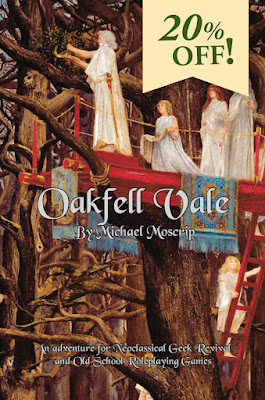
My Druid Adventure On Sale
30 November, 2023
We Need a Little Help
It has been a while since I posted here, and I now firmly intend to correct that. I have many things tell about the AD&D 2e game that I ran from 89 to 97. It took place on an imagined southern-hemisphere continent of Middle Earth. But until then, I have something serious that I have to share.
For those of you who might not know, we are Michael and Marta Moscrip. Marta is a special education para pro, working to help children with special needs in our school district succeed in school. I am a writer, focusing mostly on game materials and short stories.
My mom lived happily with us for over a year and a half. Her passing at the end of July threw us into turmoil and devastated our finances due to her lack of life insurance.
Several months ago I applied for disability due to my fibromyalgia. They contacted me recently, and the application is progressing well, but will take a little longer. However we are now two months behind on our rent and our landlord will wait no longer. We hope to be stable again within the next couple of months, but until then we are reaching out to you to help us.
It is not easy asking for help like this, but we have no choice. I pray that it will not change your opinion of who we are. We have loved living in our house. It has been our home. It is where our children grew up. We deeply appreciate any help that you can give. It means everything to us. We love you all.
https://ko-fi.com/michaelmoscrip
You can enter any amount by clicking on the box.
14 July, 2021
Oakfell Vale Out Now
![]() |
| Available Here |
04 May, 2021
![]() |
| by Andrew Domachowski |
A few years ago, on Martin Luther King Day, I wrote a short piece about an episode of the original series of Star Trek, The Ultimate Computer, episode 24 of season 2, from 1968. I think it goes a little way toward explaining what I mean by that, and I've reprinted it below.
I watched this episode again today. I watched it specifically because it was today. Mainly, this story is about limiting the extent of computer automation, and how taking risks to achieve things is a vital part of humanity. But beyond that, this episode has something perhaps less obvious to say.
At no point, during the entire episode, is any mention or reference made to the fact that Doctor Daystrom is a black man. He is the most brilliant computer scientist of his time, an unparalleled genius. He is also deeply troubled by his own legacy. He is eventually driven past his breaking point by the events of the story. But all these things are the triumphs and failures, the accolades and problems, of a scientific genius, not of 'a black man'. This character could have been played by any actor. He was played, wonderfully and passionately, by William Marshal. But the colour of his skin made no difference, in any way. He was a scientist. He was a person.
I give great credit to my parents, and to the other family surrounding me in my childhood, that I saw nothing out of the ordinary about this fact. To me, all people looked different. All individuals were unique, and yet all people were the same. We are all people. Differences in culture, language, appearance; all these were fascinating things to be learned about and appreciated. Only later, as I learned about history, and saw in the news the strange and unreasonable ways in which some people regarded such things as skin colour, did I realise how powerful the subtext of this episode was.
30 November, 2019
Dark Crystal TV Show
I tried watching the Dark Crystal tv series. I made it about 25% through the 1st ep. and shut it off. I was surprised to then see huge amounts of critical praise for it .
- The whole background of the world is changed. I suppose it's possible that some kind of 'reveal' would have the tv show background turn out to be some kind of ruse by the skeksis, but I doubt it. The revised history of who the skeksis are is not nearly as interesting, and is just dumb, right off the top. "They're from space!" takes a high concept and turns it into a cheap low-ball.- The population of the gelflings is segregated into a cheesy 'X number of cities, each with it's own bluntly simplistic character' system, like a video game or a 2000s YA novel. Another hack device.
- One of the last scenes I watched was a fly-through shot of some kind of library or scriptorium. A great deal of screen time was lavished on this space that felt like the set decorators got started on it, but didn't have time to finish. Comparing it with similar classic Henson spaces, it feels positively empty. There was also no point to the very long fly-through, except showing off the created space. This felt very unlike classic Henson and the Dark Crystal, where the awesome environments were there in support of what was going on, rather than being the point in themselves.
- The very last scene I watched was this same sort of thing again. Scene of characters talking about leaving one location and why they were going to a different location. Extended shot of them leaving, showing off creature movement, but nothing else going on. Same, from another angle. Same, from another angle. Same, from another angle. I get you worked really hard on these things, but that does not mean you give them screen time compared to how much time you spent making them. You give them screen time appropriate to the story and what you're getting across. A fail.
17 June, 2019
Gellarde Barrow
Find it here: Gellarde Barrow at DriveThruRPG
24 April, 2019
What Playing 5th Edition D&D Feels Like To Me
[I specify "to me", because I am not you, so I don't know how it feels to you. It clearly feels pretty good to quite a few people. If it feels great to you, that's awesome. I'm not attacking you, or trying to change your mind.]
[Also, below, "5e" is not in any way a DM. It is the rules system, nothing else. "Me" is myself as a player or DM, either one.]
I need to go through a door into a room where I need to solve a problem. There is a box outside the door with 68 specialised tools all jumbled together. I can take one into the room with me. I rummage through the box and pick a screwdriver, thinking "this seems versatile".
5e: "That's not 'versatile'. That tool is for driving quarter inch flathead screws, little mister, and that's all!"Me: "Uh.. ok?"
I go in the room, and there are two boards partially nailed together. I need to either finish nailing them together, or separate them. I flip the screwdriver around and start hammering the nail with the handle.
5e: "Whoa down there, tiger! As stated earlier, that's a screwdriver, not a hammer. You need to turn that back around and hold it by the handle."
I turn the screwdriver back around, and start using it to pry the two boards apart.
5e: "Hey now! No can do, MacGuyver. That screwdriver is for driving screws. I mean, it's right there in the name, see? You had plenty of opportunity on the other side of the door to pick a hammer or a crowbar, but you chose the screwdriver."
I try to put the screwdriver through my head. It does not work, because my head is not a screw.
Me: "Screw you, 5e."
26 October, 2018
Why They Put Trails Through Forests
This one is a perfect example of somewhere your DnD character does NOT want to take their horse. Not just riding, but you don't want to try to walk it through there either. All those holes and shadows that look like holes will all look like holes to your horse, and even if your horse is trained so they won't freak out in a forest (they freak out in forests because, basically, they have one eye on each side of their head) they might baulk at going anywhere near them. The other possibility (the worse one) is that they try to jump over them onto what they think is solid ground, but almost certainly isn't, at which point they will almost assuredly break either their ankle or their leg.
![]() |
| "That doesn't look so bad" - someone who doesn't ride horses |
If your character is looking at this, and they have a horse, they'll have to either find a way around or take their horse back and leave it somewhere. Unless neither the player nor the character have any experience with horses (this is pretty basic), in which case they can try to make their horse (not them) roll a wisdom save (determination) to go through it, and then a dexterity save to not break at least one leg (based on how badly they failed the save). The horse is going to have to keep making that dex save. How often depends on the ground, but potentially as often as every 5 minutes.
18 October, 2018
In The Mouth of Madness
“Trent stood at the edge of the rip; stared into the illimitable gulf of the unknown, the Stygian world yawning blackly beyond. Trent's eyes refused to close. He did not shriek, but the hideous unholy abominations shrieked for him, as in the same second he saw them spill and tumble upward out of an enormous carrion black pit choked with the gleaming white bones of countless unhallowed centuries. He began to back away from the rip as the army of unspeakable figures, twilit by the glow from the bottomless pit, came pouring at him toward our world.”
10 October, 2018
Corken for the Holidays!
![]() |
| cobaltplasma.deviantart.com |
Corken have no eyes or ears, instead using their extremely powerful and minutely discerning sense of smell. They smell with the suckered surface of their large tentacles, so if the tentacles are removed somehow, they will wander around aimlessly for a while, then give up on life and just sit down.
The traditional old-fashioned preparation of the Holiday Corken is on the left. On the right is the more recent style, where the tentacles have been removed and prepared separately, usually as a fried treat as well as an ingredient in other dishes. A few people in larger cities, such as Cooperton or Frippert, now put tentacle in the stuffing, but this is frowned on by all but the middle and upper classes.
14 January, 2017
Stupid Monk Tricks
Combat Balance, or Karma Strain, or Chi Balance, or whatever funky monk name you want to call it.
When the monk does damage in a fight, they can arbitrarily add bonus points to their damage. But! They must achieve b a l a n c e. During the fight they have to apply an equal amount of MINUS POINTS to their damage. If they don’t, then a turn later they will take that many D6s in damage to themselves, as their muscles pop and snap from the strain. If someone casts something like Lesser Restoration on the monk before the turn is up, this will quiet their muscles and they won’t take the damage, but the monk will still have Failed to Achieve Balance (covered later). Something like a Cure Wounds spell won’t help at all, though it will have its normal effect on the damage after the monk’s muscles have snapped.
Let’s Have an Example!
Jovaell the Monk is in a fight again! She hits Bandit Leader for 3 points of damage, and is deeply unfulfilled. She is a professional, so she knows this hit is wimply, and decides to DRIVE HER IRON WILL INTO HIS BODY! She adds.. Hmm.. 7 points! Yes, she feels that’s prudent, and adds 7, doing 10 all together. Bandit Leader falls to the ground, the victim, ultimately, of his own poor life choices.
But now Jovaell must achieve BALANCE!
She strikes Lackey X, and hits, doing 4 points of damage. She subtracts 3 from that, doing a total of 1 point. She MUST do at least one point of damage with the hit, or she can achieve no balance with it. 7-3=4. She still has 4 points of her earlier bonus damage she needs to make up for before she has achieved balance.
To her dismay, Lackey X drops in front of her, the victim of Nabonidas the Assassin. He seems pleased with himself.
![]() |
| Jovaell the Monk, in case you forgot |
She now has a few options. Her friend Cormac the druid is senile, and has nothing like a restoration spell prepared. She sees a nearby goat. She has never liked goats. Not since the Goat Incident. She hits the goat and rolls an exciting 6 points of damage! Unfortunately for everyone concerned, it was an Old Goat, and had but one hit point to give up. To achieve any balance, the goat would have to take at least 1hp in damage anyway, so she still has 2 points of Chi Strain (or whatever) to unload, even though the goat shatters like a chair in a bar fight from that 6.
She will hit Nabonidas. She will make it up to him later, and he probably deserves it anyway. Assassin, amiright?
She cracks him a good one for 5 points, subtracts the 2 that was building up dangerously, hurting him for a total of 3pts, and has ZEROED OUT HER YANG WITH HER YIN! YAY!
BUT!
She Failed To Achieve Balance during the fight. She has avoided physical damage, but her Inner Calm (or something) pays the price. She gets no combat xp from that fight. Or maybe just half. Up to your DM.
09 September, 2015
Sigh.
![]() |
| My KotOR Characters. Of Course. |
I love spending time with my friends, and I love the fantastic worlds that I get to visit. A majority of my problem, I think, is the long-running basic assumption that DnD characters are largely greedy self-serving bastards. Having this as a core premise has always been a downer for me. Even though it can be amusing from time to time, the constant exposure to this paradigm has, I think, really worn me down.
I remember trying to play Dark Side in KotOR for a while, and it didn't last long at all. I laughed a couple times, but got bored with it quickly. It made the game dreary and unfun for me.
I tried to play Renegade Shepard in Mass Effect 2. Again, a few laughs. When the crew had concerns about spacing Grunt if he went crazy, and Shepard just shrugged and grinned after making a point about having extra crewmembers, I thought it was hilarious. But I stopped playing that save and went back to my paragon version soon after. I didn't like Bad Shep, and didn't care what happened to him. Playing him felt like a tedious chore.
I tried playing a Skyrim character who broke laws, went to jail, killed innocuous bystanders, etc. Same result. Lame. Quit playing that one before level 15. When my son was playing and decided to get turned into a vampire and eat people at Vampire Castle, I tried to keep watching, but lost all interest.
I know all these examples are from video games, and involve me trying to play 'the bad guy' rather than being enmired in their midst, but I guess my point is it's just not in me. It's not fun for me. Rather than getting any emotional relief from parodying or lampooning assholes by being an asshole, I get my relief by smashing the assholes. I'm kind of afraid that this means I'm simple or naive, but I can’t deny that it all adds up to me beginning to experience my chosen hobby as another source of depression rather than a refuge from it.
19 November, 2014
Anglian Religion and World View - Airtha, Fairwhus
![]() |
| A different group of travellers meets elves |
![]() |
| Map of Yggdrasil - Tina Solstrand solaroid.deviantart.com |
Admittedly, there was some advantage to this. Theodoric had specifically claimed all of “Ælfheim” as his.
As more diverse members of what the Romans had called “The Germanic Tribes” continued to find their way to this other place, some even rejected the notion that they had ever left Midgard at all.
And with that, we have the current spectrum covering most opinion. At one extreme, “it’s all just more Europe” and at the other extreme, “every new landmass here is a different one of the nine worlds.” Some are even certain that one could sail to Asgard or Hel; they just haven’t been found yet. The most common view throughout the Empire, and in Anglia as well, is that:
- This is indeed not Midgard.
- Neither Asgard nor Hel reside upon this sphere.
- The six more earthly homelands of legend (Ælfheim, Vanaheim, Niflheim, Jotunheim, Muspelheim, and Svartalfheim) are in fact merely different continents on this world.
The third point is deep heresy in the eyes of the Church, and can land one in deep trouble back in the Old Empire if bandied about publicly. Interestingly, although still technically heresy, the Church in Anglia tends to overlook this. Anglia, of course, happens to rest on a continent explorers named Jotunheim.
10 November, 2014
NPC Parties
![]() |
| Nabonidas of Akhdar |
Below is a party of NPCs that I used in a slightly different way. I placed them in one of the rooms of the Temple Catacombs under the ruined temple at the corner of Castle Nicodemus. But then I put one member of their party on the random encounter chart for the Catacombs. That way they might run into him first (chasing a polymorphed but defeated green slaad), giving the players the opportunity to interact with him, trace his steps back to the rest of the NPC party, or some combination of the two (or ignore him altogether, of course). The players also might run into the main body of the NPC party first, thus hearing about their recent defeat of a green slaad who bolted and ran rather than giving over the soul gem embedded in its forehead. The players could then choose to interact with the NPC party, help them track down their “ranger” who chased off after the slaad, try to avoid them, attack them for their loot, or anything else the players might think of. (You might recognise the ranger, the green slaad polymorphed into a raven, and his party of companions. If you do, please let me know in the comments or on G+. The basic idea for them, though not their party composition, is lifted from some old pre-WOTC TSR product, but I can’t remember which one.)
The first question I addressed about them was “why are they there?” I decided they were a professional treasure hunting company hired to find a specific item. In addition to providing some variety from the usual simple lust for loot, this choice also snuck in some incidental information about the campaign world. Anglia and other nearby kingdoms and locales are rich enough in ruins to support a professional company of delvers. The ruins are known to hold highly valuable or powerful items, widely enough that multiple patrons would seek to hire delvers. The ruins are known to be dangerous; dangerous enough to warrant hiring professionals instead of delving on one’s own.
Another factor I consider when putting a party of NPCs into a dungeon is time. Just how long are they going to be in there? There’s obviously a limit (unless the dungeon is big enough to get lost in), but until the players have some clue they are down there, there probably isn’t any reason to start their clock ticking. For this party, the clock started when the players found their tracks heading down into the Temple Catacombs entrance. After that, they would be leaving the dungeon after a maximum of 1d10+14 days. (If I was stopping time between game sessions, I probably would have made that quite a bit less.) I had them camp in the temple ruins just above, but if the Catacombs had been larger I would probably have had them hole up in an empty room down below. Being professionals, they were fastidious campers who left no glaring evidence. Each day a game session occurred, they had a chance to notice the players, modified by how close the players got to the ruined temple, or how loud and obvious the players’ characters became.
The last question I wanted to answer before they encountered players was “how will they act toward another group of adventurers?” Even though I knew I wanted to come up with one or two basic character traits for each member, I wanted an overall party MO as well. Although their alignments differ individually, on the whole they will work toward good ends, beneficent to most of society and the innocent, and will do their best to limit the amount of chaos caused (or Chaos unleashed) in getting there. Being professionals working on a contract, they will do their best not to reveal their current employer, or what they’ve been hired to retrieve. If they can “foil some evil” without risking their contract, they’ll do it.
![]() |
| Jovaell the Monk |
The next big consideration for the individuals is what their hit dice should be. Again since I knew they were professionals, I decided they would have researched the item they’re after and its location as much as possible. Therefore, they’d be unlikely to be in over their heads in the Temple Catacombs. Other monsters down there included wights, wraiths, several areas where glyphs are set up to summon red slaad, a medusa, and at least one summoned green slaad. 6 to 8 hit dice (9 for the leader) sounded about right, while still making it difficult enough for them to progress so that they wouldn’t end up clearing the dungeon instead of the players. This would also determine things like their available spells and other special abilities.
- Darius Ravenwood, Ranger, 8hd. Jovial and boastful, which interferes with keeping contracts confidential.
- Nabonidas, Assassin, 7hd. Soft-spoken, pleased with himself. The “common peoples’” antics amuse him.
- Tasha, Elf Illusionist, 9hd. The Company Leader. Friendly, but all-business underneath.
- Jovaell, Monk, 6hd. Quiet and introspective. Hard to tell if she’s observing or meditating.
- Cormac O’ Connacht, Druid, 7hd. Old and sort of senile. Prone to confusion and revealing secrets.
I’ll give more details about some of these NPCs later on, as at least one has another function in Anglia. Tasha is one of several possible mentor choices for 1st level magic-users.
07 November, 2014
News from Castle Nicodemus
Winter is solidly entrenched in the Anglish countryside, with leafless woods, clear cold skies, and snow-blanketed fields only occasionally punctuated by patches of brown grass. The first sabbat appropriate for placating Dagon down in the fens of Blackmarch to “benevolently” allow conversion to Tsathoggua has long passed, but another approaches in early February, only a couple months away.
| The traditional Anglish corken roast |
In Castle News, Cadogan Dee, mercenary footman, languishes in one of the Renard’s Folly jail cells, suspected of the murders of other mercenaries Niels Noorlander, Helmut the Saxon, and Harbrecht of Utrecht. Found cowering in the cold shelter of a rubble pile near the Castle edifice dubbed “The Great Laboratory,” Dee still claims “I don’t remember anything!” The Dutch contingent is particularly doubtful of his innocence, owing in no small part to the blood on Dee’s lips when found holding Harbrecht’s severed hand.
18 August, 2014
My Known World - Western Half
Here's a map of the Western half of the known area of my "Ruins of the Morvalian Empire" game world.
17 August, 2014
How Bugbears are Born
![]() |
| Sort of, but 8 feet long and way more gross. |
14 August, 2014
Character for Marvel '78
13 August, 2014
Niflheim and The Spike
17 April, 2014
Chance and Timing of Wilderness Encounters
Columns
Instead of using arbitrary units like hours or days, this system divides time into more natural sections based on sunrise, sunset, and the typical activity cycle of creatures outdoors. If your world has 2 suns or 60 hour days or other vastly different time schemes, just alter the column titles as appropriate, or add or remove whatever columns you need to make it work.
Rows
As far as the rows are concerned, you just need to have one for each encounter table (the thing that lists the actual monsters) that you've made.
"Aww jeeeez, this looks so complicated!" Bah, whinger! The idea is to make it as quick as possible while playing; to give the DM a rich answer to the question "does anything happen?" using as little dice rolling as possible. Then the DM rolls on their list of monsters/events/etc. for that area.
Dawn
|
Morning
|
Afternoon
|
Twilight
|
Evening
|
Night
| |
Plains
|
2d6-9
|
2d6-10
|
2d6-10
|
2d6-9
|
2d6-10
|
2d6-10
|
Forest
|
2d6-10
|
2d6-9
|
2d6-10
|
2d6-8
|
2d6-9
|
2d6-8
|
Desert
|
2d6-10
|
2d6-11
|
-
|
2d6-11
|
2d6-10
|
2d6-9
|
Etc.
|
As an example, if 2d6-9 is used for encounter chance, and an event is rolled on any double result, the overall chance of something happening is 1 in 3. Half would be encounters and half would be events. If instead 2d6-11 is used for encounter chance, and events are rolled on a result of either double ones or double twos, the overall chance of something happening is 1 in 12, with events being twice as likely as encounters.